
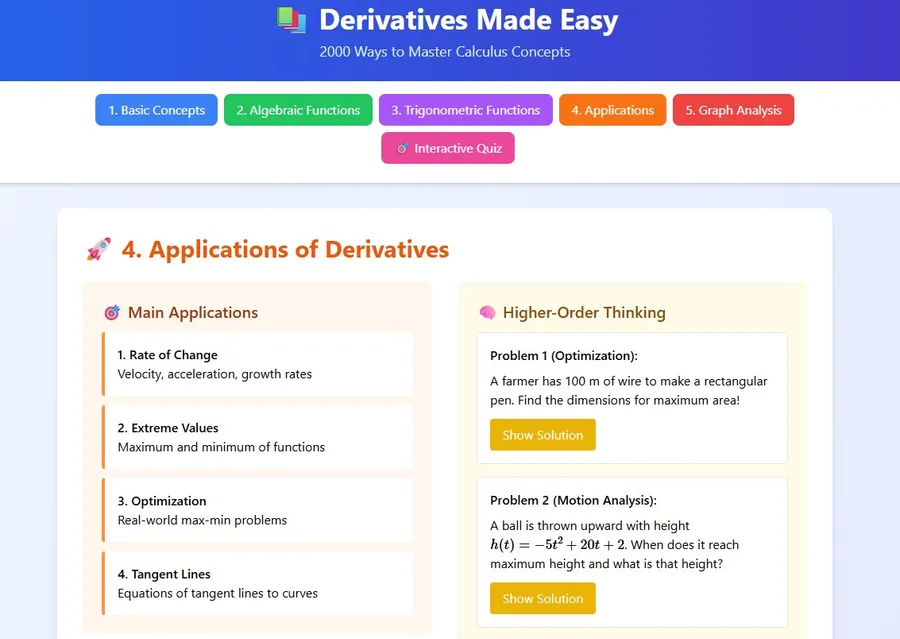
Discover real-life applications of derivatives in physics, economics, and more. Includes practice problems and visual examples for high school students.
Table Of Contents
📘 Applications of Derivatives
Master How Derivatives Solve Real-Life and Advanced Math Problems
🎯 Why Are Derivatives Useful?
Derivatives are not just abstract math — they describe real-world change. From calculating how fast a car is moving to maximizing profits, derivatives are tools that help us understand dynamic systems.
This article will explore the major applications of derivatives:
- Rates of change (velocity, acceleration)
- Tangents and normals
- Maxima and minima
- Optimization problems
- Curve sketching
🛣️ 1. Rates of Change: Velocity & Acceleration
📌 Concept:
If $s(t)$ is a position function, then:
- $s'(t)$ = velocity
- $s''(t)$ = acceleration
🚗 Example 1: Velocity and Acceleration
A car’s position is given by:
$$ s(t) = 3t^2 + 2t $$
Find its velocity and acceleration.
- $v(t) = s'(t) = 6t + 2$
- $a(t) = s''(t) = 6$
✅ Interpretation: Velocity changes with time, but acceleration is constant (uniform acceleration).
📐 2. Tangent and Normal Lines
✏️ Tangent Line:
If $f(x)$ is a function, the tangent line at $x = a$ is:
$$ y = f'(a)(x - a) + f(a) $$
✏️ Normal Line:
The normal line is perpendicular to the tangent line:
$$ \text{slope} = -\frac{1}{f'(a)} $$
📌 Example 2: Find Tangent and Normal at $x = 1$
Let $f(x) = x^2$, find equations at $x = 1$
$f(1) = 1$, $f'(x) = 2x \Rightarrow f'(1) = 2$
Tangent: $y = 2(x - 1) + 1 = 2x - 1$
Normal: Slope = -1/2 → $y = -\frac{1}{2}(x - 1) + 1 = -\frac{1}{2}x + \frac{3}{2}$
🏔️ 3. Maximum and Minimum (Extrema)
We use first and second derivatives to analyze the peaks and valleys of functions.
📌 First Derivative Test:
- $f'(x) = 0$ → critical point
- Use sign changes to determine max or min
📌 Second Derivative Test:
- If $f''(x) > 0$, it’s a minimum
- If $f''(x) < 0$, it’s a maximum
🔍 Example 3: Find Local Max/Min
Let $f(x) = -x^2 + 4x$
- $f'(x) = -2x + 4 = 0 \Rightarrow x = 2$
- $f''(x) = -2 < 0$ → maximum at $x = 2$
$$ f(2) = -(2)^2 + 4(2) = -4 + 8 = 4 $$
✅ So, max point is (2, 4)
🧠 4. Optimization Problems
Use derivatives to solve real-life problems like minimizing cost, maximizing area, or efficiency.
📦 Example 4: Maximize Area
A rectangle has a perimeter of 20. What’s the maximum area?
Let width = $x$, length = $10 - x$
$$ A = x(10 - x) = 10x - x^2 $$
- $A'(x) = 10 - 2x = 0 \Rightarrow x = 5$
- Max area at $x = 5 \Rightarrow A = 25$
✅ A square gives the max area for fixed perimeter.
📈 5. Curve Sketching with Derivatives
Use:
- First derivative: slope, critical points
- Second derivative: concavity and inflection points
📉 Example 5: Sketching a Curve
Given $f(x) = x^3 - 3x$:
- $f'(x) = 3x^2 - 3 = 3(x^2 - 1) \Rightarrow x = ±1$
- $f''(x) = 6x$
Test concavity:
- $f''(-1) = -6 < 0$ → concave down
- $f''(1) = 6 > 0$ → concave up
✅ Inflection at $x = 0$, max at $x = -1$, min at $x = 1$
💡 HOTS Problem
A company’s profit $P(x) = -2x^2 + 40x - 150$, where $x$ is the number of units sold.
Find:
- The number of units to maximize profit
- The maximum profit
🧠 Solution:
- $P'(x) = -4x + 40 = 0 \Rightarrow x = 10$
- $P(10) = -2(10)^2 + 40(10) - 150 = -200 + 400 - 150 = 50$
✅ Max profit is 50 when 10 units are sold.
🧪 Practice Problems
📊 Standard
- Find the tangent line to $f(x) = \sin x$ at $x = \pi/4$
- Find the minimum of $f(x) = x^2 + 6x + 9$
- Given $s(t) = t^3 - 3t^2$, find velocity and acceleration
🔥 HOTS
- A fence of length 100 m is to enclose a rectangular area against a wall. Maximize the area.
- A box with square base and open top must hold 32 cm³. Minimize the surface area.
🔁 Summary Table
| Application | Technique Used | Math Tool |
|---|---|---|
| Velocity | First derivative | $s'(t)$ |
| Acceleration | Second derivative | $s''(t)$ |
| Tangent line | Derivative at a point | $f'(a)$ |
| Max/Min | 1st/2nd derivative tests | $f'(x), f''(x)$ |
| Optimization | Critical points of models | Derivatives |
| Sketching graph | Critical + inflection pts | $f', f''$ |