
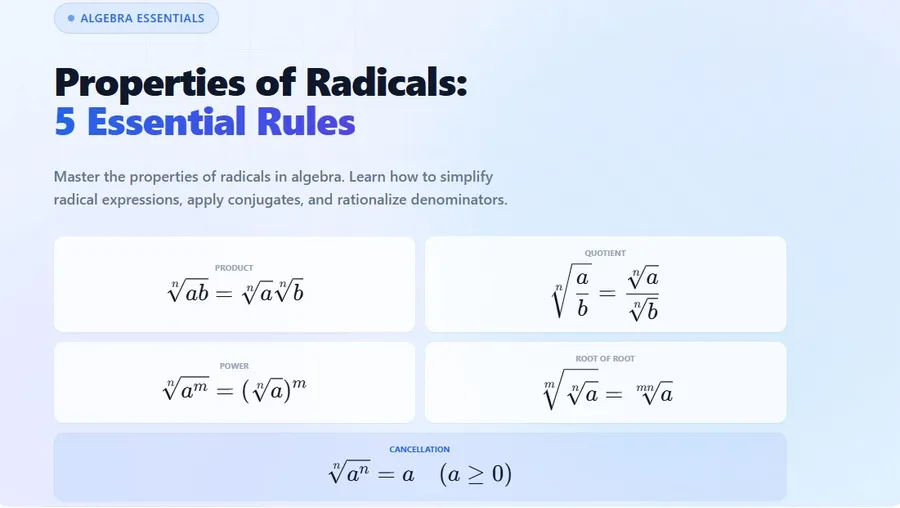
Master the properties of radicals in algebra. Learn how to simplify radical expressions, apply conjugates, and rationalize denominators with clear equations. Read now!
Table Of Contents
The properties of radicals are fundamental algebraic rules utilized to simplify and manipulate root expressions. These properties include the distributive law for combining like radicals and the application of binomial conjugates—derived from the difference of squares identity $(a+b)(a-b) = a^2 - b^2$—to perform rationalization. Mathematically, a radical expression represents a root of a number, which frequently yields an irrational value. Mastery of these operational properties allows students to seamlessly convert rational exponents into radical forms and solve higher-level algebraic equations.
The Mechanics of Radicals
1. The Relationship Between Exponents and Radicals
A radical expression serves as an alternative notation for a rational exponent. Assuming $a$ is a real number and $n > 0$, the formal definitions are established as follows:
- Basic Identity $$a^{\frac{1}{n}} = \sqrt[n]{a}$$
- General Radical Form $$a^{\frac{m}{n}} = (\sqrt[n]{a})^m = \sqrt[n]{a^m}$$
- Inverse Property $$(\sqrt[n]{a})^n = a,(a \ge 0 \text{ if } n \text{ is even})$$
2. Operations and the Distributive Property
Radical terms can be combined through addition or subtraction exclusively when they constitute like radicals, meaning they share the same index and the identical radicand.
- Addition: $$a\sqrt{c} + b\sqrt{c} = (a+b)\sqrt{c}$$
- Subtraction: $$a\sqrt{c} - b\sqrt{c} = (a-b)\sqrt{c}$$
- Product Property:
Radicals with identical indices can be multiplied under a single radical sign: $$\sqrt{a} \times \sqrt{b} = \sqrt{ab}$$
3. Conjugates and Rationalizing the Denominator
Eliminating a radical from a denominator requires a process known as rationalizing the denominator. This method relies on binomial conjugates to exploit the difference of squares identity.
- Monomial Denominators:
For $\frac{a}{\sqrt{b}}$, multiply the expression by $\frac{\sqrt{b}}{\sqrt{b}}$. - Binomial Denominators:
For $\frac{c}{\sqrt{a} + \sqrt{b}}$, multiply the expression by the conjugate form $\frac{\sqrt{a} - \sqrt{b}}{\sqrt{a} - \sqrt{b}}$. - The Algebraic Result:
The denominator expands to $(\sqrt{a})^2 - (\sqrt{b})^2$, which simplifies to the rational value $a - b$.
Worked Example Problems
Example 1: Multiplying Radicals
Simplify the expression $(2\sqrt{x})(3\sqrt[3]{x})$ for $x > 0$.
Solution 1 $$\begin{align*} (2\sqrt{x})(3\sqrt[3]{x}) &= (2x^{\frac{1}{2}})(3x^{\frac{1}{3}}) \\ &= (2 \times 3) \cdot x^{\frac{1}{2} + \frac{1}{3}} \\ &= 6x^{\frac{3}{6} + \frac{2}{6}} \\ &= 6x^{\frac{5}{6}} \\ &= 6\sqrt[6]{x^5} \end{align*}$$
Example 2: Rationalizing Using Binomial Conjugates
Rationalize the denominator of the fraction $\frac{2}{\sqrt{3} + \sqrt{5}}$.
Solution 2 $$\begin{align*} \frac{2}{\sqrt{3} + \sqrt{5}} &= \frac{2}{\sqrt{3} + \sqrt{5}} \times \frac{\sqrt{3} - \sqrt{5}}{\sqrt{3} - \sqrt{5}} \\ &= \frac{2(\sqrt{3} - \sqrt{5})}{(\sqrt{3})^2 - (\sqrt{5})^2} \\ &= \frac{2(\sqrt{3} - \sqrt{5})}{3 - 5} \\ &= \frac{2(\sqrt{3} - \sqrt{5})}{-2} \\ &= -1(\sqrt{3} - \sqrt{5}) \\ &= \sqrt{5} - \sqrt{3} \end{align*}$$
Tips & Common Misconceptions
A frequent logical error in algebra is assuming that the square root distributes over addition: $\sqrt{a+b} = \sqrt{a} + \sqrt{b}$. This statement is false.
Consider the counterexample $\sqrt{9+16} = \sqrt{25} = 5$. Evaluating the terms individually yields $\sqrt{9} + \sqrt{16} = 3 + 4 = 7$. Since $5 \neq 7$, the operations within the radicand must always be computed prior to extracting the root.
Another common oversight involves applying the incorrect sign to a binomial conjugate. If a denominator is expressed as $a - \sqrt{b}$, its corresponding conjugate must be $a + \sqrt{b}$. Inverting the sign is required to ensure the cancellation of the middle terms during expansion.
Self-Practice Exercises
Level 1: Knowledge & Understanding
- Classify which of the following expressions evaluate to an irrational radical expression (surd) and justify the reasoning: $\sqrt{49}$, $\sqrt{11}$, and $\sqrt{0.64}$.
- Simplify the radical expression $\sqrt{75} - \sqrt{12} + \sqrt{48}$ into its simplest single radical form.
- Determine whether the expression $\sqrt{2\sqrt{2\sqrt{4}}}$ evaluates to a rational number or an irrational radical.
Level 2: Application
- Rationalize the denominator of the following algebraic expression using the conjugate property: $\frac{m}{\sqrt{m} + n}$.
- Expand and simplify the product of the following binomial radical expressions: $(3\sqrt{2} - 2\sqrt{3})(3\sqrt{2} + 2\sqrt{3})$.
- Rationalize the denominator of the following expression containing a rationalized numerator: $\frac{\sqrt{x} - 2}{x - 4}$ for $x \neq 4$ and $x \ge 0$.
Level 3: Higher-Order Thinking Skills (HOTS)
- A spiral seashell is modeled using a sequence of contiguous right-angled triangles. Each triangle has an outer leg measuring $1\text{ cm}$. If the hypotenuse of the $n$-th chamber is given by the formula $\sqrt{n+1}\text{ cm}$, calculate the length of the hypotenuse for the 8th chamber and determine whether this value constitutes an irrational radical expression.
- An equilateral triangle has a side length of $\frac{6}{\sqrt{3}}\text{ cm}$. Find the exact area of the triangle and determine whether the final numerical value is an irrational radical expression. (Note: The area of an equilateral triangle with side $s$ is $A = \frac{1}{4}s^2\sqrt{3}$).
Conclusion
Mastering the properties of radicals is an essential milestone in introductory algebra. Understanding the structural connection between rational exponents and radical signs allows for the efficient simplification of complex expressions. Furthermore, utilizing binomial conjugates ensures that final solutions can be converted into standard mathematical form by clearing radicals from the denominator. Continuous application of these core rules builds the necessary foundation for advanced academic topics, including trigonometry and calculus.
Comprehensive Answer Key
Level 1: Knowledge & Understanding
- Question 1 Solution $$\begin{align*} \sqrt{49} &= 7 \quad (\text{Rational}) \\ \sqrt{11} &\approx 3.3166… \quad (\text{Irrational}) \\ \sqrt{0.64} &= 0.8 \quad (\text{Rational}) \end{align*}$$ Only $\sqrt{11}$ represents an irrational radical expression (surd) because its decimal expansion is non-terminating and non-repeating.
- Question 2 Solution $$\begin{align*} \sqrt{75} - \sqrt{12} + \sqrt{48} &= \sqrt{25 \times 3} - \sqrt{4 \times 3} + \sqrt{16 \times 3} \\ &= 5\sqrt{3} - 2\sqrt{3} + 4\sqrt{3} \\ &= (5 - 2 + 4)\sqrt{3} \\ &= 7\sqrt{3} \end{align*}$$
- Question 3 Solution $$\begin{align*} \sqrt{2\sqrt{2\sqrt{4}}} &= \sqrt{2\sqrt{2 \times 2}} \\ &= \sqrt{2\sqrt{4}} \\ &= \sqrt{2 \times 2} \\ &= \sqrt{4} \\ &= 2 \end{align*}$$ Since $2 \in \mathbb{Z}$ (an integer), the expression evaluates to a rational number and is NOT an irrational radical.
Level 2: Application
- Question 1 Solution $$\begin{align*} \frac{m}{\sqrt{m} + n} &= \frac{m}{\sqrt{m} + n} \times \frac{\sqrt{m} - n}{\sqrt{m} - n} \\ &= \frac{m(\sqrt{m} - n)}{(\sqrt{m})^2 - n^2} \\ &= \frac{m(\sqrt{m} - n)}{m - n^2} \end{align*}$$
- Question 2 Solution $$\begin{align*} (3\sqrt{2} - 2\sqrt{3})(3\sqrt{2} + 2\sqrt{3}) &= (3\sqrt{2})^2 - (2\sqrt{3})^2 \\ &= (9 \times 2) - (4 \times 3) \\ &= 18 - 12 \\ &= 6 \end{align*}$$
- Question 3 Solution $$\begin{align*} \frac{\sqrt{x} - 2}{x - 4} &= \frac{\sqrt{x} - 2}{(\sqrt{x})^2 - 2^2} \\ &= \frac{\sqrt{x} - 2}{(\sqrt{x} - 2)(\sqrt{x} + 2)} \\ &= \frac{1}{\sqrt{x} + 2} \end{align*}$$ To rationalize the denominator of the resulting expression: $$\begin{align*} \frac{1}{\sqrt{x} + 2} &= \frac{1}{\sqrt{x} + 2} \times \frac{\sqrt{x} - 2}{\sqrt{x} - 2} \\ &= \frac{\sqrt{x} - 2}{x - 4} \end{align*}$$
Level 3: Higher-Order Thinking Skills (HOTS)
- Question 1 Solution $$\begin{align*} H(8) &= \sqrt{8 + 1} \\ &= \sqrt{9} \\ &= 3 \text{ cm} \end{align*}$$ Since $3 \in \mathbb{Q}$ (a rational number), the final length is NOT an irrational radical expression.
- Question 2 Solution $$\begin{align*} A &= \frac{1}{4} \left( \frac{6}{\sqrt{3}} \right)^2 \sqrt{3} \\ &= \frac{1}{4} \left( \frac{36}{3} \right) \sqrt{3} \\ &= \frac{1}{4} (12) \sqrt{3} \\ &= 3\sqrt{3} \text{ cm}^2 \end{align*}$$ The exact area is $3\sqrt{3}\text{ cm}^2$. Since $\sqrt{3}$ is an irrational number, the final value is an irrational radical expression.
Did this guide clarify how to use the properties of radicals? Leave a comment below with your answers to our Level 3 challenges! Share this article with your peers to help them master algebra. To expand your mathematical skill set, explore our next comprehensive guide on Logarithm Rules and Applications.