
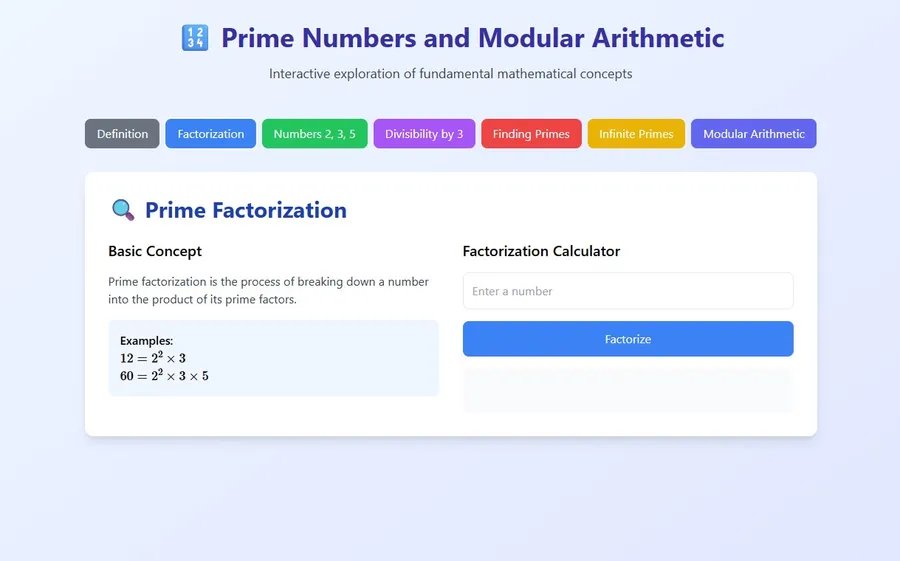
Complete guide to prime factorization: definition, methods, solved examples, and real-life applications for high school math.
Table Of Contents
Prime Factorization: Definition, Steps, Examples, and Applications
1. Introduction
Prime factorization is the process of breaking down a positive integer into a product of prime factors. This concept is very important in mathematics because it forms the basis for finding the GCD (Greatest Common Divisor), LCM (Least Common Multiple), and solving various problems in number theory and modular arithmetic.
For high school students, understanding prime factorization helps master many other topics such as fractions, equations, and even cryptography.
2. Definition of Prime Factorization
Definition: Prime factorization is the representation of a positive integer $n > 1$ as the product of one or more prime numbers.
General form:
$$ n = p_1^{a_1} \times p_2^{a_2} \times \dots \times p_k^{a_k} $$
where:
- $p_1, p_2, \dots, p_k$ are prime numbers,
- $a_1, a_2, \dots, a_k$ are positive integers.
Example:
$$ 60 = 2^2 \times 3 \times 5 $$
Its prime factors: 2, 3, 5.
3. Why is Prime Factorization Important?
- Finding GCD & LCM: With prime factorization, we can quickly find common factors and common multiples.
- Simplifying fractions: Fractions can be reduced by dividing numerator and denominator by their common prime factors.
- Cryptography: Digital security systems like RSA rely on the difficulty of factoring large numbers.
- Fundamental Theorem of Arithmetic: States that every positive integer $n > 1$ has a unique prime factorization (only the order of the factors differs).
4. Methods of Prime Factorization
4.1. Repeated Division Method
- Start with the smallest prime number (2).
- Divide the number until it can no longer be divided.
- Continue to the next prime number (3, 5, 7, …).
- Repeat until the result is 1.
Example:
$$ 84 \div 2 = 42,\quad 42 \div 2 = 21,\quad 21 \div 3 = 7,\quad 7 \div 7 = 1 $$
Prime factors: $2^2 \times 3 \times 7$.
4.2. Factor Tree Method
- Write the number at the top.
- Break it into two factors.
- Break down each non-prime factor until all factors are prime numbers.
Example:
Result: $84 = 2^2 \times 3 \times 7$.
5. Example Problems and Solutions
Problem 1
Factor 90 into its prime factors.
Solution:
$$ 90 \div 2 = 45,\quad 45 \div 3 = 15,\quad 15 \div 3 = 5,\quad 5 \div 5 = 1 $$
Result: $90 = 2 \times 3^2 \times 5$.
Problem 2
Use prime factorization to find the GCD of 72 and 108.
Solution:
$$ 72 = 2^3 \times 3^2 $$
$$ 108 = 2^2 \times 3^3 $$
GCD = $2^{\min(3,2)} \times 3^{\min(2,3)} = 2^2 \times 3^2 = 36$.
Problem 3
Use prime factorization to find the LCM of 45 and 60.
Solution:
$$ 45 = 3^2 \times 5 $$
$$ 60 = 2^2 \times 3 \times 5 $$
LCM = $2^{\max(0,2)} \times 3^{\max(2,1)} \times 5^{\max(1,1)} = 2^2 \times 3^2 \times 5 = 180$.
6. Common Mistakes
- Stopping before all prime factors are found: Sometimes students forget to break down the last composite factor.
- Order doesn’t matter, but some think you must always start with 2. In fact, the order can vary, the result is the same.
- Thinking 1 is a prime factor: 1 is a factor of all numbers, but it is not a prime number.
7. Applications of Prime Factorization in Real Life
- Scheduling: Determining when two events coincide using LCM.
- Data Encryption: Encoding information using pairs of large prime numbers.
- Coding Science: Creating efficient algorithms for primality testing.
8. Independent Exercises
- Factor 126 into its prime factors.
- Find the GCD of 54 and 90 using prime factorization.
- Find the LCM of 32 and 48 using prime factorization.
Short Answer Key:
- $126 = 2 \times 3^2 \times 7$
- GCD = $18$
- LCM = $96$
9. Interesting Facts
- Factoring very large numbers with hundreds of digits takes a very long time, even with supercomputers.
- Large prime numbers are used as “public keys” in encryption, and prime factorization becomes the “private key”.
📚 Related: Prime Numbers: Definition, Properties, Examples, and Applications↝
📚 See also: Theorem of Multiples of 3: Rules, Proof, and Examples↝
10. Conclusion
Prime factorization is a basic skill that every high school student must master. Not only is it useful for GCD and LCM problems, but it also plays a vital role in modern technology, especially in data security.