
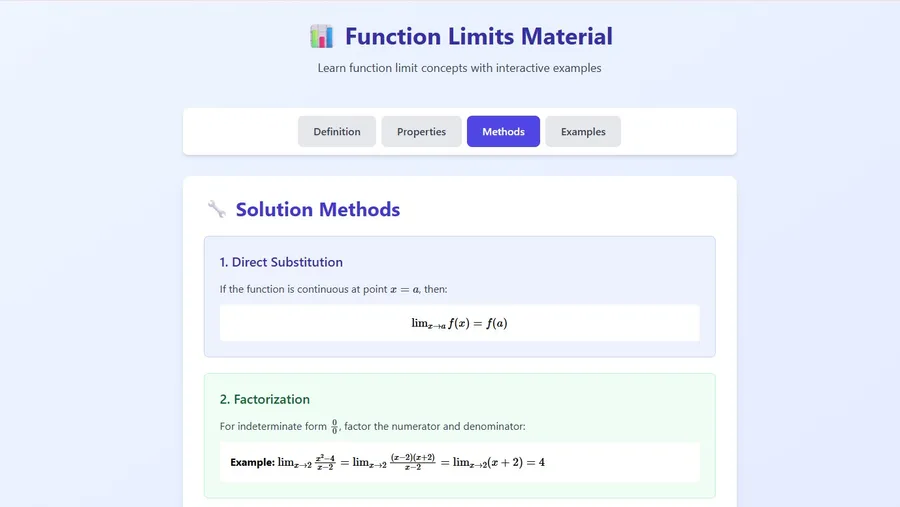
Learn methods for calculating function limits using direct substitution, factorization, and conjugate multiplication techniques. Includes HOTS example problems and complete solutions. Essential for grade 11 high school students!
Why do you need a method?
Not all limits can be solved using direct substitution. Sometimes, we encounter indeterminate forms such as:
- $\frac{0}{0}$
- $\frac{\infty}{\infty}$
- $\infty - \infty$
Therefore, we need several important methods to simplify the function first.
🔎 1. Direct Substitution
The most basic method. Simply replace $x$ with the limit value.
Example:
$$ \lim_{x \to 1} (3x^2 - 2x + 4) \Rightarrow 3(1)^2 - 2(1) + 4 = 3 - 2 + 4 = \boxed{5} $$
✅ Suitable if the result exists directly and is not an indeterminate form.
🧩 2. Factorization
Use this when substitution results in an indeterminate form, such as $\frac{0}{0}$.
Example:
$$ \lim_{x \to 2} \frac{x^2 - 4}{x - 2} $$
The numerator can be factored:
$$ = \frac{(x - 2)(x + 2)}{x - 2} \Rightarrow x + 2 \Rightarrow \lim_{x \to 2} x + 2 = \boxed{4} $$
✅ Use for quadratic functions, algebraic forms, and when factoring is possible.
🔄 3. Conjugate Multiplication
Useful for indeterminate forms involving roots.
Example:
$$ \lim_{x \to 9} \frac{\sqrt{x} - 3}{x - 9} $$
Multiply by the conjugate:
$$ \cdot \frac{\sqrt{x} + 3}{\sqrt{x} + 3} = \frac{x - 9}{(x - 9)(\sqrt{x} + 3)} = \frac{1}{\sqrt{x} + 3} \Rightarrow \frac{1}{6} $$
✅ Used to simplify root expressions.
📏 4. Limits of Complex Fractional Functions
If the function consists of fractions within fractions, simplify first.
Example:
$$ \lim_{x \to 0} \frac{1}{x} - \frac{1}{x + 1} \Rightarrow \frac{(x + 1) - x}{x(x + 1)} = \frac{1}{x(x + 1)} \Rightarrow \text{Continue with substitution if not indeterminate} $$
🧮 5. Limits with Special Trigonometric Forms
Some important formulas:
- $\lim_{x \to 0} \frac{\sin x}{x} = 1$
- $\lim_{x \to 0} \frac{1 - \cos x}{x} = 0$
Example:
$$ \lim_{x \to 0} \frac{\sin 5x}{x} = \lim_{x \to 0} \frac{5 \cdot \sin 5x}{5x} = 5 \cdot 1 = \boxed{5} $$
✅ Frequently appears in trigonometric limits and national exams.
📝 Practice Problems and Solutions
Problem 1:
$$ \lim_{x \to 1} \frac{x^2 - 1}{x - 1} \Rightarrow \frac{(x - 1)(x + 1)}{x - 1} = x + 1 \Rightarrow \boxed{2} $$
Problem 2:
$$ \lim_{x \to 0} \frac{\sqrt{1 + x} - 1}{x} \Rightarrow \text{Multiply by the conjugate:} \cdot \frac{\sqrt{1 + x} + 1}{\sqrt{1 + x} + 1} \Rightarrow \frac{x}{x(\sqrt{1 + x} + 1)} = \frac{1}{\sqrt{1 + x} + 1} \Rightarrow \boxed{\frac{1}{2}} $$
L’Hôpital’s Method: L’Hôpital’s Method for Function Limits↝ Continue to: Function Limit Example Problems and Solutions↝ Or go back to: Definition of Function Limits↝