
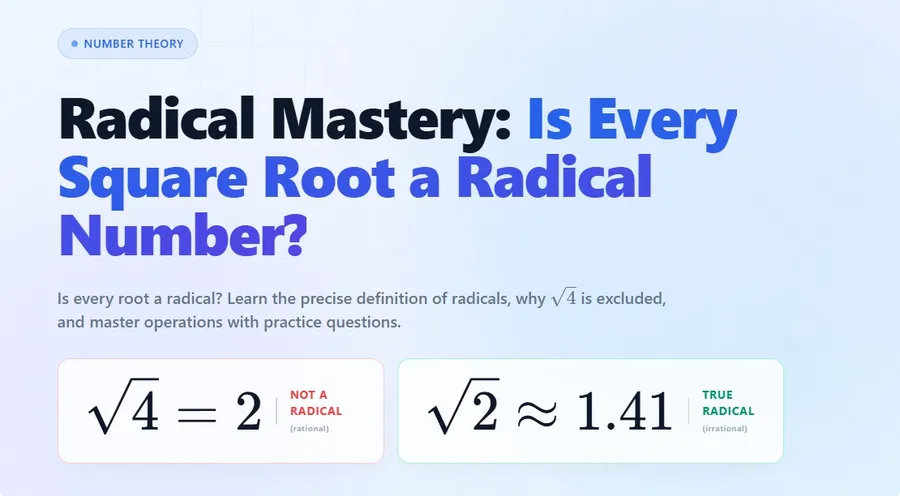
Is every root a radical? Learn the precise definition of radicals, why root of 4 is excluded, and master Grade 10 radical operations with practice questions. Read now!
Table Of Contents
In mathematics, a radical (often referred to as a surd or root number) is specifically defined as a root of a number that results in an irrational number. While $\sqrt{4}$ looks exactly like a radical expression, it simplifies perfectly to $2$, which is a rational number. Therefore, $\sqrt{4}$ is technically not considered a true radical in mathematical grouping. In contrast, expressions like $\sqrt{2}$ or $\sqrt{3}$ are true radicals because their values are infinite, non-repeating decimals. This guide will help Grade 10 students clearly identify, understand, and simplify these essential mathematical expressions.
Understanding Radicals and Roots
The Link Between Powers and Roots
A root is simply another way to write a fractional exponent. The mathematical relationship between powers and roots is defined as follows:
- The Formula: For rational powers, $a^{m/n} = \sqrt[n]{a^m}$.
- Base and Index: In $\sqrt[n]{a^m}$, $a$ is the base (radicand) and $n$ is the root index.
- The Condition: The denominator $n$ must be a positive integer ($n > 0$).
Why $\sqrt{4}$ is Not a Radical Number
In high school mathematics, we must draw a strict line between a standard root operation and a radical number.
- Rational Roots: If evaluating a root results in a whole number or a clean fraction, it is rational. For example, $\sqrt{4} = 2$ and $\sqrt{0.25} = 0.5$.
- Irrational Roots (True Radicals): These roots cannot be written as simple fractions. Their decimal representations go on forever without any repeating pattern.
- Identification Rule: Always check if the number under the square root is a perfect square. If it is not, then the expression is a true radical.
Mathematical Operations with Radicals
You can manipulate radical expressions using laws similar to exponent properties:
- Multiplication Rule: You can multiply two radicals if they share the exact same index: $\sqrt{a} \times \sqrt{b} = \sqrt{ab}$.
- Power of a Radical: The property $(\sqrt[n]{a})^n = a$ holds true for all real values where $a \ge 0$.
Example Problems
Example 1: Identifying Radicals
Which of the following expressions are true radicals: $\sqrt{9}$, $\sqrt{5}$, and $\sqrt{16}$?
- Step 1: Evaluate $\sqrt{9}$. The result is $3$. This is a rational number, so it is NOT a radical.
- Step 2: Evaluate $\sqrt{5}$. The result is approximately $2.236…$ (irrational). This IS a radical.
- Step 3: Evaluate $\sqrt{16}$. The result is $4$. This is a rational number, so it is NOT a radical.
- Result: Only $\sqrt{5}$ is a true radical number.
Example 2: Simplifying Expressions
Simplify the expression: $(2\sqrt{x})(3\sqrt[3]{x})$ for $x > 0$.
- Step 1: Convert the radicals into fractional exponents. This gives us $(2x^{1/2})(3x^{1/3})$.
- Step 2: Multiply the numerical coefficients together: $2 \times 3 = 6$.
- Step 3: Combine the variables by adding their exponents: $\frac{1}{2} + \frac{1}{3} = \frac{3}{6} + \frac{2}{6} = \frac{5}{6}$.
- Final Result: $6x^{5/6}$ or $6\sqrt[6]{x^5}$.
Tips & Common Mistakes
A very common mistake among students is assuming that $\sqrt{a+b} = \sqrt{a} + \sqrt{b}$. This is strictly FALSE.
Proof: Let’s look at $\sqrt{9+16}$.
- Correct way: $\sqrt{9+16} = \sqrt{25} = 5$.
- Incorrect way: $\sqrt{9} + \sqrt{16} = 3 + 4 = 7$.
Since $5 \neq 7$, you must always perform the addition inside the root sign first.
Another frequent error is using the wrong sign when rationalizing a denominator. If a denominator looks like $\sqrt{a} + \sqrt{b}$, its conjugate is $\sqrt{a} - \sqrt{b}$. Using the incorrect sign will fail to eliminate the radical from the bottom of your fraction.
Self-Practice Exercises
- Level 1: Understanding & Knowledge
Identify which of the following expressions is a true radical and explain your reasoning: $\sqrt{25}$, $\sqrt{7}$, $\sqrt{100}$. - Level 2: Application
Simplify the expression $\sqrt{32} \times \sqrt{2}$ and determine if the final calculated result is a radical. - Level 3: Reasoning / HOTS (Higher-Order Thinking Skills)
 Consider a geometric shell model where each chamber forms a right-angled triangle with a base of 1 cm. If the hypotenuse of the $n$-th chamber is given by the formula $\sqrt{n+1}$, find the exact length of the hypotenuse for the 3rd chamber. Is this final length a radical?
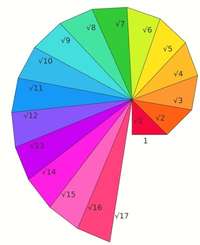 Consider a geometric shell model where each chamber forms a right-angled triangle with a base of 1 cm. If the hypotenuse of the $n$-th chamber is given by the formula $\sqrt{n+1}$, find the exact length of the hypotenuse for the 3rd chamber. Is this final length a radical?
Conclusion
The mathematical definition of a radical is strictly bound to irrational roots. While any real number can be written under a root sign, only those that cannot be simplified into rational numbers are true radicals. Mastering this distinction allows you to easily simplify complex algebraic equations and solve practical geometric formulas.
Did this article clear up your confusion about $\sqrt{4}$? Let us know in the comments section below if you managed to solve the Level 3 seashell problem! Don’t forget to share this guide with your classmates to help them master radicals too.
Short Answer Key:
- Level 1: Only $\sqrt{7}$ is a true radical; the others evaluate cleanly to the rational numbers $5$ and $10$.
- Level 2: $\sqrt{32 \times 2} = \sqrt{64} = 8$. The final result is NOT a radical.
- Level 3: Using the formula for $n=3$, we get $\sqrt{3+1} = \sqrt{4} = 2$ cm. The final result is NOT a radical.