
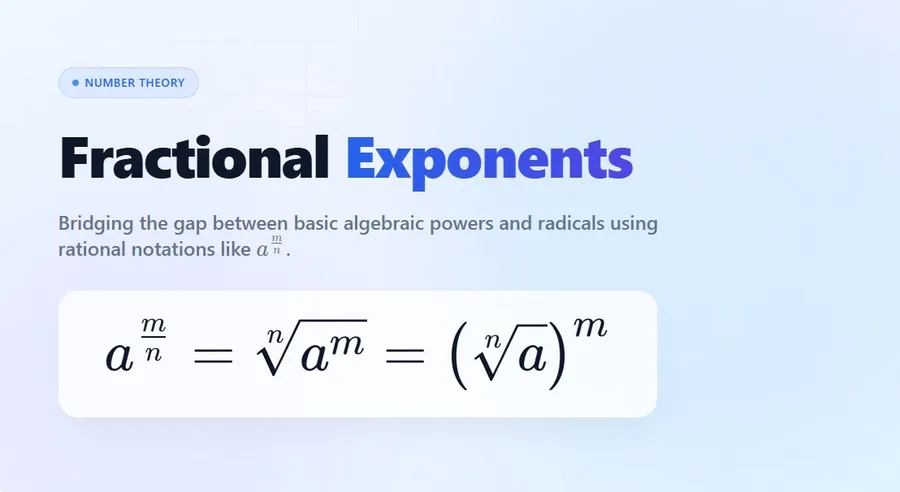
Learn everything about fractional exponents. Understand formulas, properties, and solve problems with our easy guide. Start mastering math today!
Table Of Contents
A fractional exponent is a mathematical notation where the power is a rational number. It is formally defined as $a^{\frac{m}{n}} = \sqrt[n]{a^m}$ or $\left(\sqrt[n]{a}\right)^m$. This notation bridges the gap between basic powers and radicals. If you see $x^{\frac12}$, it simply means the square root of $x$. Understanding these exponents is essential for solving complex algebraic equations. It also helps in modeling real-world growth and decay.
Understanding the Definitions
The Basic Definition
Fractional exponents represent roots of a number. According to the Grade 10 Revised Edition, there are three critical definitions for these powers:
- Unit Fractional Exponents: If $a$ is a real number and $n$ is a positive integer, then $a^{\frac{1}{n}} = p$ means $p^n = a$.
- General Fractional Exponents: For any rational power $\frac{m}{n}$, then $$a^{\frac{m}{n}} = \left(a^{\frac{1}{n}}\right)^m$$
- Radical Form: The expression $a^{\frac{m}{n}}$ can also be written as $\sqrt[n]{a^m}$.
Key Conditions
To ensure the math remains valid, specific conditions must be met:
- The base ($a$) must be a real number.
- In most cases, $a \neq 0$ to avoid undefined values.
- The denominator of the exponent ($n$) must be a positive integer ($n > 0$).
Applying Exponent Properties
The same rules that apply to whole-number exponents also apply to pangkat pecahan. These include:
- Multiplication: $$a^m \cdot a^n = a^{m+n}$$
- Division: $$\frac{a^m}{a^n} = a^{m-n}$$
- Power of a Power: $$\left(a^m\right)^n = a^{m \times n}$$
Example Problems
Example 1: Simplifying with Unit Exponents
Simplify the expression $\left(x^{\frac{1}{3}}\right)^2 \times x^{\frac{4}{3}}$ for $x > 0$.
Solution 1:
- Step 1: Apply the “Power of a Power” property. $$\left(x^{\frac{1}{3}}\right)^2 = x^{\frac{1}{3} \times 2} = x^{\frac{2}{3}}$$
- Step 2: Apply the “Multiplication” property. $$x^{\frac{2}{3}} \times x^{\frac{4}{3}} = x^{(\frac{2}{3} + \frac{4}{3})}$$
- Step 3: Add the fractions. $$x^{\frac{6}{3}} = x^2$$
- Final answer: $x^2$.
Or in simpler form: $$\begin{align*} \left(x^{\frac{1}{3}}\right)^2 \times x^{\frac{4}{3}} &= x^{\frac{2}{3}} \times x^{\frac{4}{3}}\\ &= x^{\frac{2}{3}+\frac{4}{3}}\\ &= x^{\frac{6}{3}}\\ &= x^2\\ \end{align*}$$
Example 2: Converting Roots to Powers
Simplify the expression $(2\sqrt{x})(3\sqrt[3]{x})$ for $x > 0$.
Solution 2:
- Step 1: Convert the radicals to fractional exponents. This gives $(2x^{\frac{1}{2}})(3x^{\frac{1}{3}})$.
- Step 2: Multiply the coefficients. $2 \times 3 = 6$.
- Step 3: Add the exponents using the “Product of Powers” property. $\frac{1}{2} + \frac{1}{3} = \frac{3}{6} + \frac{2}{6} = \frac{5}{6}$.
- Final Answer: $6x^{\frac{5}{6}}$ or $6\sqrt[6]{x^5}$.
in simpler form: $$\begin{align*} (2\sqrt{x})(3\sqrt[3]{x}) &= (2x^{\frac{1}{2}})(3x^{\frac{1}{3}}) \\ &= (2 \times 3) \cdot x^{\frac{1}{2} + \frac{1}{3}} \\ &= 6x^{\frac{3}{6} + \frac{2}{6}} \\ &= 6x^{\frac{5}{6}} \text{ or } 6\sqrt[6]{x^5} \end{align*}$$
Tips & Common Mistakes
A common logic error is assuming that $\sqrt{a+b} = \sqrt{a} + \sqrt{b}$. This is mathematically false. For example, $\sqrt{9+16}$ is $\sqrt{25}=5$, but $\sqrt{9}+\sqrt{16}$ is $3+4=7$. Always perform the addition inside the root first.
Another mistake is confusing the “Power” and the “Root.” Always remember the “Power over Root” mnemonic. In the term $a^{\frac{m}{n}}$, the top number ($m$) is the power, and the bottom number ($n$) is the root index.
Quick Trick: If you have a negative fractional exponent like $a^{-\frac{1}{2}}$, flip the base first to make it a positive exponent: $\frac{1}{a^{\frac12}}$ or $\frac{1}{\sqrt{a}}$.
Self-Practice Exercises
Level 1: Basic Knowledge
Express $\sqrt[4]{b^3}$ in fractional exponent form ($a^{\frac{m}{n}}$). Identify the base, the power, and the root index.
Level 2: Application
Simplify the following expression: $$\left(\frac{8x^5 y^{-4}}{16y^{-4}}\right)^{\frac{1}{2}}$$ Use exponent properties to reach the simplest form.
Level 3: HOTS (Higher Order Thinking Skills)
A light filter allows 60% of light to pass through. Determine how many filters are needed so that the remaining light intensity is less than 5% of the original. Model this using exponential equations or logarithms.
Conclusion
The concept of fractional exponents (pangkat pecahan) is a vital tool in the Grade 10 Merdeka Curriculum. It allows students to move fluidly between powers and roots, simplifying complex algebraic terms. By mastering the basic definitions and properties, you can tackle advanced topics like exponential functions and logarithms with confidence. Consistent practice with both radicals and fractions will ensure your mathematical success.
Did this guide help you understand fractional exponents? Leave a comment below with your answer to the Level 2 practice problem! Don’t forget to share this article with your classmates. For more Grade 10 math tips, check out our guide on Mastering Logarithm Basics!
Key Answer & Explanations:
Level 1: $b^{3/4}$.
Base = $b$, Power = $3$, Root index = $4$.
Level 2: $\frac{x^2\sqrt{x}}{\sqrt{2}}$ atau $\frac{x^2\sqrt{2x}}{2}$
Step Solution: $$\begin{align*}\left(\frac{8x^5 y^{-4}}{16y^{-4}}\right)^{\frac{1}{2}} &= \left(\frac{1x^5 y^{-4 - (-4)}}{2}\right)^{\frac{1}{2}} \\ &= \left(\frac{x^5 y^0}{2}\right)^{\frac{1}{2}} \\ &= \left(\frac{x^5}{2}\right)^{\frac{1}{2}} \\&= \frac{x^{\frac52}}{2^{\frac12}} \\ &= \frac{x^{2}\cdot x^\frac12}{2^{\frac12}} \\ &= \frac{x^2\sqrt{x}}{\sqrt{2}} \times \frac{\sqrt{2}}{\sqrt{2}}\\ &= \frac{x^2\sqrt{2x}}{2}\end{align*}$$
Level 3 Answer: A minimum of 6 filters are required.
Step-by-Step Solution:- Step 1: Set up the inequality where $n$ is the number of filters. Since each filter allows 60% (0.6) of light to pass, the remaining intensity after $n$ filters must be less than 5% (0.05).$$(0.6)^n < 0.05$$
- Step 2: Apply logarithms (base 10) to both sides of the inequality. $$\log(0.6^n) < \log(0.05)$$
- Step 3: Use the power property of logarithms ($\log(a^b) = b \cdot \log(a)$) to bring down the exponent $n$. $$n \cdot \log(0.6) < \log(0.05)$$
- Step 4: Divide both sides by $\log(0.6)$. Since $\log(0.6)$ is a negative number ($\approx -0.222$), you must flip the inequality sign from $<$ to $>$. $$n > \frac{\log(0.05)}{\log(0.6)}$$
- Step 5: Calculate the decimal values using a calculator. $$n > \frac{-1.301}{-0.222} \approx 5.86$$
- Conclusion: Since the number of filters must be a whole number, the smallest integer greater than 5.86 is 6. Therefore, at least 6 filters are needed.