
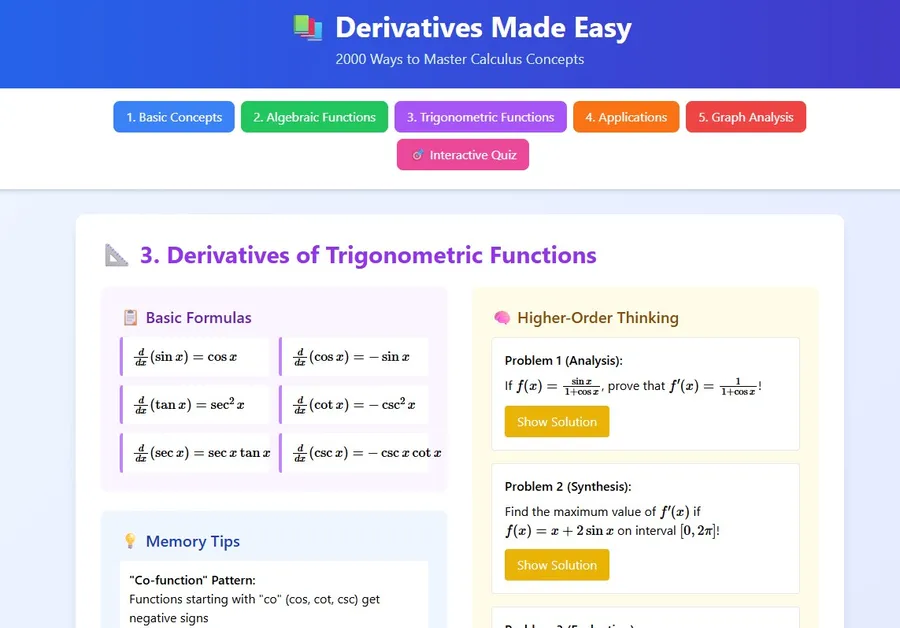
Master trigonometric derivatives like sin, cos, and tan with clear rules, solved examples, and practice problems for high school calculus learners.
Table Of Contents
📘 Derivatives of Trigonometric Functions
Master Derivatives of Sine, Cosine, and More — With Easy Rules and Examples
🧭 Introduction: Trigonometry Meets Calculus
Trigonometric functions describe waves, circular motion, and periodic behavior — from sound vibrations to tides. Understanding their derivatives helps us model real-world change.
This article will walk you through:
- Basic derivatives of trig functions
- Rules for combined and composite functions
- Applications with practice and HOTS-level problems
🎯 Basic Derivatives of Trigonometric Functions
Let’s start with the standard six trig functions:
| Function | Derivative |
|---|---|
| $\sin x$ | $\cos x$ |
| $\cos x$ | $-\sin x$ |
| $\tan x$ | $\sec^2 x$ |
| $\cot x$ | $-\csc^2 x$ |
| $\sec x$ | $\sec x \tan x$ |
| $\csc x$ | $-\csc x \cot x$ |
These are essential. Memorize them early — they’re used often in exams and applications.
🧩 Applying the Chain Rule
When a trig function has something more complex inside it (like $\sin(3x)$ or $\cos(x^2)$), we use the chain rule:
If $f(x) = \sin(g(x))$, then:
$$ f'(x) = \cos(g(x)) \cdot g'(x) $$
🔁 Example 1: Derivative of $\sin(3x)$
Let $f(x) = \sin(3x)$
- Outer: $\sin(u) \Rightarrow \cos(u)$
- Inner: $u = 3x \Rightarrow u' = 3$
Then:
$$ f'(x) = \cos(3x) \cdot 3 = 3\cos(3x) $$
🔁 Example 2: Derivative of $\cos(x^2)$
Let $f(x) = \cos(x^2)$
- Outer: $\cos(u) \Rightarrow -\sin(u)$
- Inner: $u = x^2 \Rightarrow u' = 2x$
Then:
$$ f'(x) = -\sin(x^2) \cdot 2x = -2x\sin(x^2) $$
🔁 Using Product and Quotient Rules with Trig
✴️ Example 3: Product Rule
Let $f(x) = x \cdot \cos x$
Then:
$$ f'(x) = (1)(\cos x) + x(-\sin x) = \cos x - x\sin x $$
✴️ Example 4: Quotient Rule
Let $f(x) = \frac{\sin x}{x}$
Then:
$$ f'(x) = \frac{\cos x \cdot x - \sin x \cdot 1}{x^2} = \frac{x\cos x - \sin x}{x^2} $$
This appears in physics and engineering when analyzing oscillations and waves.
🌊 Application in Real Life: Sound Waves
The position of a vibrating string is modeled by:
$$ s(t) = 5\sin(2\pi t) $$
To find the velocity, take the derivative:
$$ s'(t) = 5 \cdot 2\pi \cos(2\pi t) = 10\pi \cos(2\pi t) $$
This gives the instantaneous velocity of the vibration.
🧠 HOTS Problem: Trig & Chain Rule
Let $f(x) = \tan(x^2 + 1)$
Find $f'(x)$
🧠 Solution Sketch:
- Outer: $\tan(u) \Rightarrow \sec^2(u)$
- Inner: $u = x^2 + 1 \Rightarrow u' = 2x$
So:
$$ f'(x) = \sec^2(x^2 + 1) \cdot 2x = 2x \sec^2(x^2 + 1) $$
🧪 Practice Problems (Standard)
Differentiate the following:
- $f(x) = \cos x$
- $f(x) = \tan(3x)$
- $f(x) = \frac{\sin x}{x}$
- $f(x) = x^2 \cdot \cos x$
- $f(x) = \cot(x^3)$
🔥 HOTS Practice Problems
🚀 Problem 1:
A pendulum swings with angle modeled by:
$$ \theta(t) = 4\cos(\sqrt{t}) $$
Find the angular velocity $\theta'(t)$
🚀 Problem 2:
Let $f(x) = \frac{\tan x}{x^2 + 1}$
Find $f'(x)$ and identify where it is zero on the interval $[0, \pi/2)$
🎯 Summary Table
| Expression | Derivative |
|---|---|
| $\sin x$ | $\cos x$ |
| $\cos x$ | $-\sin x$ |
| $\tan x$ | $\sec^2 x$ |
| $\sin(3x)$ | $3\cos(3x)$ |
| $x\cos x$ | $\cos x - x\sin x$ |
| $\frac{\sin x}{x}$ | $\frac{x\cos x - \sin x}{x^2}$ |
| $\tan(x^2)$ | $2x\sec^2(x^2)$ |