
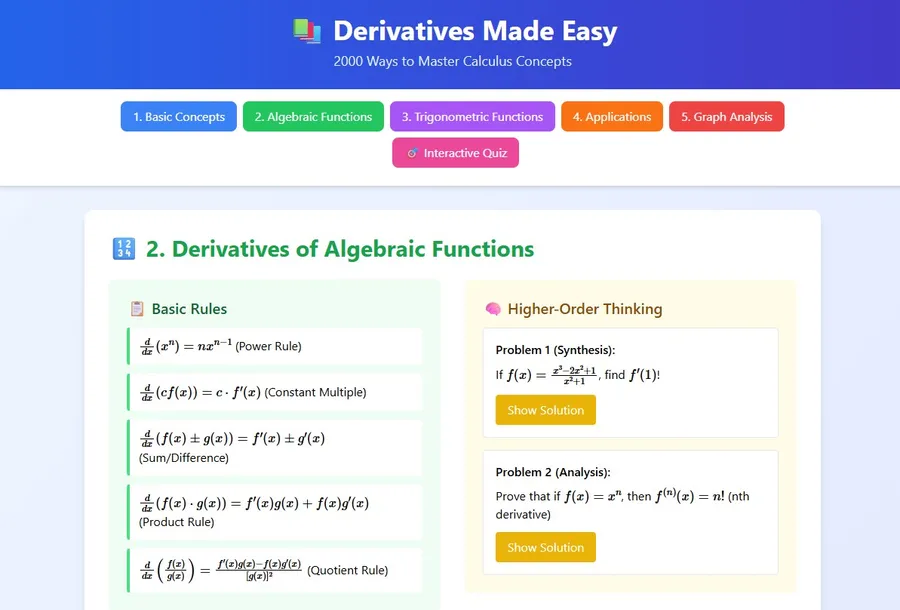
Learn to differentiate algebraic functions using power, constant, product, and quotient rules. Includes step-by-step examples and HOTS problems.
📘 Derivatives of Algebraic Functions
Mastering the derivative rules is essential for solving various problems in calculus. One of the key topics is understanding how to find algebraic functions derivatives systematically. With the power rule explained clearly, students can easily identify patterns when differentiating power functions. When dealing with division, using a solid quotient rule example helps simplify the process. Additionally, applying a product rule shortcut can make differentiating the product of two functions much faster. For more complex expressions, learning the derivative of rational functions is extremely useful. Even root expressions are covered through techniques like the derivative of square root, which extends the power rule. This article also features hots math derivative problems for those looking to challenge their higher-order thinking skills. All materials and exercises are tailored for high school calculus practice, making it ideal for students aiming to strengthen their understanding of derivatives.
🧭 Introduction: From Concept to Application
In the previous article, we explored what derivatives mean and how they describe change. Now it’s time to apply that understanding to actual functions.
Most of the functions you’ll encounter — in math class or real life — are algebraic. These include:
- Polynomials: $f(x) = x^3 + 2x - 5$
- Rational functions: $f(x) = \frac{2x+1}{x^2+3}$
- Radical functions: $f(x) = \sqrt{x}$, etc.
Let’s learn how to find their derivatives quickly and accurately.
🎯 Key Derivative Rules for Algebraic Functions
🔢 1. Constant Rule
If $f(x) = c$, where $c$ is a constant, then:
$$ f'(x) = 0 $$
Why? Because constants don’t change, so their rate of change is zero.
🧮 2. Power Rule
If $f(x) = x^n$, then:
$$ f'(x) = nx^{n-1} $$
This rule works for any real number $n$: integers, fractions, even negatives.
Examples:
- $\frac{d}{dx}(x^4) = 4x^3$
- $\frac{d}{dx}(x^{-2}) = -2x^{-3}$
- $\frac{d}{dx}(\sqrt{x}) = \frac{1}{2\sqrt{x}}$
➕ 3. Sum & Difference Rule
If $f(x) = g(x) + h(x)$ or $f(x) = g(x) - h(x)$, then:
$$ f'(x) = g'(x) \pm h'(x) $$
This rule lets you take derivatives term-by-term.
✖️ 4. Product Rule
If $f(x) = g(x) \cdot h(x)$, then:
$$ f'(x) = g'(x)h(x) + g(x)h'(x) $$
Think of it as: “First derivative × second + first × second derivative”
➗ 5. Quotient Rule
If $f(x) = \frac{g(x)}{h(x)}$, then:
$$ f'(x) = \frac{g'(x)h(x) - g(x)h'(x)}{[h(x)]^2} $$
This rule is essential when differentiating fractions.
✅ Examples by Function Type
✴️ Example 1: Polynomial Function
Let $f(x) = 3x^4 - 2x^2 + 5x - 7$
Differentiate term-by-term using the power rule:
$$ f'(x) = 12x^3 - 4x + 5 $$
✴️ Example 2: Rational Function
Let $f(x) = \frac{2x + 3}{x^2}$
Method 1: Rewrite First
$$ f(x) = 2x^{-1} + 3x^{-2} \Rightarrow f'(x) = -2x^{-2} - 6x^{-3} $$
Method 2: Quotient Rule (if preferred) Use only when simplification is hard or not possible.
✴️ Example 3: Radical Function
Let $f(x) = \sqrt{x^3} = x^{3/2}$
$$ f'(x) = \frac{3}{2}x^{1/2} $$
✴️ Example 4: Product Rule
Let $f(x) = (2x + 5)(x^2 - 3)$
Let:
- $g(x) = 2x + 5 \Rightarrow g'(x) = 2$
- $h(x) = x^2 - 3 \Rightarrow h'(x) = 2x$
Then:
$$\begin{align*}f'(x) &= g'(x)h(x) + g(x)h'(x)\\&= 2(x^2 - 3) + (2x + 5)(2x)\\&= 2x^2 - 6 + 4x^2 + 10x\\&= 6x^2 + 10x - 6\end{align*}$$
🔥 HOTS Application Problem
A company models its profit with:
$$ P(x) = \frac{x^2 + 2x + 3}{x + 1} $$
Question:
- Find $P'(x)$ using the quotient rule
- At what value of $x$ does profit increase the fastest?
🧠 Solution Sketch:
Let:
- $g(x) = x^2 + 2x + 3 \Rightarrow g'(x) = 2x + 2$
- $h(x) = x + 1 \Rightarrow h'(x) = 1$
Apply quotient rule:
$$ P'(x) = \frac{(2x + 2)(x + 1) - (x^2 + 2x + 3)(1)}{(x + 1)^2} $$
Simplify the numerator and analyze the critical points for max increase.
🧪 Practice Problems (Basic)
Differentiate the following:
- $f(x) = 5x^3 - x + 8$
- $f(x) = \frac{3x^2 + 2}{x}$
- $f(x) = x^2\sqrt{x}$
- $f(x) = (x^3 + 1)(x - 2)$
🎯 Practice Problems (Advanced / HOTS)
Let $f(x) = \frac{x^2 + 3x - 1}{\sqrt{x}}$
- Rewrite in power form
- Differentiate
- Interpret what the derivative tells you about the function’s growth rate at $x = 4$
📌 Tips for Mastery
- Rewrite roots and fractions using exponents before differentiating.
- Apply power rule first — most problems can be simplified using it.
- Don’t rush the quotient rule — write all steps clearly to avoid errors.
- Always simplify your final answer unless instructed otherwise.
📚 Summary Table
| Function Type | Rule to Use | Derivative Example |
|---|---|---|
| Constant | Constant Rule | $f(x) = 7 \Rightarrow f'(x) = 0$ |
| $x^n$ | Power Rule | $f(x) = x^3 \Rightarrow 3x^2$ |
| Sum/Difference | Linear Rule | $f(x) = x^2 + 2x \Rightarrow 2x + 2$ |
| Product | Product Rule | $f(x) = (x+1)(x-1) \Rightarrow \ldots$ |
| Quotient | Quotient Rule | $f(x) = \frac{g(x)}{h(x)} \Rightarrow \ldots$ |