
Learn the exponent definition to solve complex math problems easily. This guide covers bases, powers, and rules for Grade 10. Start mastering math today!
Table Of Contents
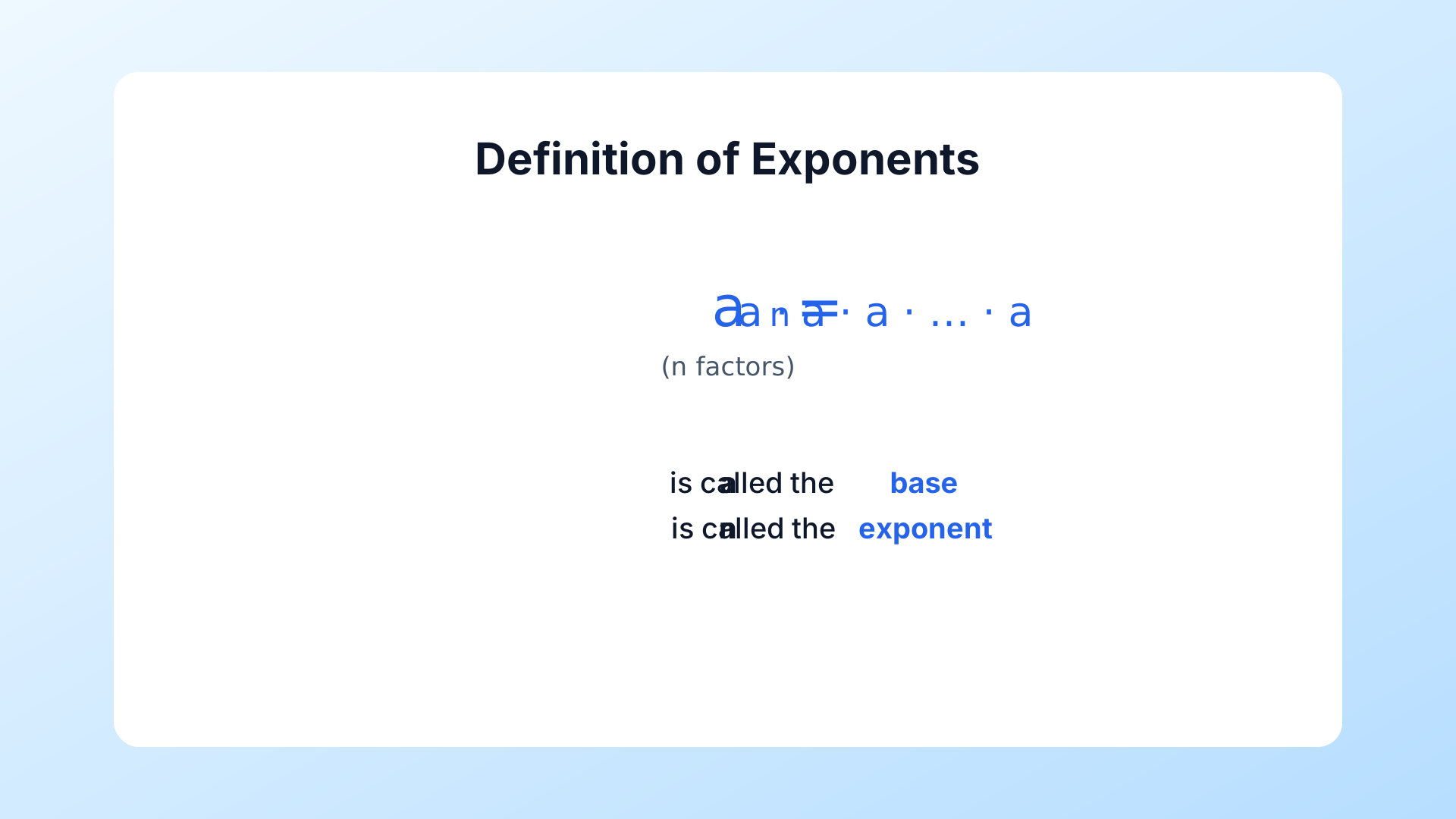
The exponent definition is a mathematical notation representing the repeated multiplication of a number by itself. In the expression $a^n$, the number $a$ is the base, while $n$ is the exponent or power. This means the base $a$ is multiplied by itself $n$ times. For example, $2^3$ is $2 \times 2 \times 2$, which equals 8. Understanding exponents is vital for analyzing real-world growth patterns, such as the spread of viral videos or population increases.
The Mechanics of Exponents
What is an Exponent?
Exponents simplify how we write long strings of multiplication. Instead of writing $5 \times 5 \times 5 \times 5$, we simply write $5^4$.
- The Base ($a$): This is the “bilangan pokok” or the number being multiplied.
- The Exponent ($n$): This is the “pangkat” or the number of times the base appears.
- The Result: The final value after completing the multiplication.
According to the official curriculum, if $a$ is a real number and $n$ is a positive integer, then $a^n$ is the product of $a$ for $n$ factors. The mathematical formula is written as:
$$a^n = \underbrace{a \cdot a \cdot a \cdots a}_{n \text{ factors}}$$.
Negative and Fractional Exponents
The definition of exponents extends beyond positive integers. Students must understand these three critical definitions:
- Negative Exponents: If $a \neq 0$, then $a^{-n} = (\frac{1}{a})^n$.
- Unit Fractional Exponents: $a^{\frac{1}{n}} = p$ means that $p^n = a$.
- General Fractional Exponents: $a^{\frac{m}{n}} = \left(a^{\frac{1}{n}}\right)^m$.
These variations allow us to calculate roots and inverse values using the same logical framework as basic powers.
Real-World Applications
Exponents are not just for textbooks. They model phenomena in our daily lives.
- Social Media: A viral video spreads when 10 people share it with 10 more, creating $10^2$ viewers, then $10^3$, and so on.
- Biology: Bacteria often reproduce by splitting into two, following the pattern $2^n$.
- Digital Security: Exponents help calculate how fast a hoax can spread through messaging apps.
Example Problems
Example 1: Basic Multiplication Simplify and calculate the value of $7^3$.
- Step 1: Identify the base and exponent. Here, the base is 7 and the exponent is 3.
- Step 2: Write the repeated multiplication. $7 \times 7 \times 7$.
- Step 3: Solve. $49 \times 7 = 343$.
- Result: 343.
Example 2: Negative Exponents Simplify the expression $2^{-3}$.
- Step 1: Use the negative exponent definition $a^{-n} = (\frac{1}{a})^n$.
- Step 2: Substitute the values. $2^{-3} = (\frac{1}{2})^3$.
- Step 3: Calculate the power. $\frac{1}{2} \times \frac{1}{2} \times \frac{1}{2} = \frac{1}{8}$.
- Result: $\frac{1}{8}$ or 0.125.
Tips & Common Mistakes
A frequent error students make is multiplying the base by the exponent. For example, they might think $3^2$ is 6. Always remember that $3^2$ means $3 \times 3$, which is 9.
Another common mistake involves negative bases. The placement of parentheses is crucial. $(-2)^4$ equals 16 because the negative sign is included in the multiplication. However, $-2^4$ equals $-16$ because only the 2 is raised to the power of 4.
Quick Trick: To remember fractional exponents, think of “Power over Root.” In $a^{m/n}$, $m$ is the power and $n$ is the root index.
Self-Practice Exercises
- Write the expression $15 \times 15 \times 15 \times 15$ in exponent form and identify the base.
- Calculate the value of $\frac{2^5 \cdot 2^3}{2^2}$ using exponent properties.
- A scientist observes a bacteria colony that doubles every hour. If there are 2,000 bacteria at the start ($t=0$), how many bacteria will there be after 10 hours? Model this using a function.
Conclusion
The exponent definition is the foundation of algebraic growth and decay. By understanding that exponents represent repeated multiplication, students can master complex topics like logarithms and functions. Whether calculating compound interest or tracking a virus, exponents provide the necessary mathematical tools to describe the world.
Did this breakdown help you understand exponents better? Leave a comment below with your answer to the Level 3 exercise! Don’t forget to share this article with your classmates. If you want to learn more, check out our next guide on Logarithms and Their Inverses.
Key Answer:
- Level 1: $15^4$; Base = 15.
- Level 2: $2^6 = 64$.
- Level 3: $f(x) = 2,000 \times 2^{10} = 2,048,000$ bacteria.