
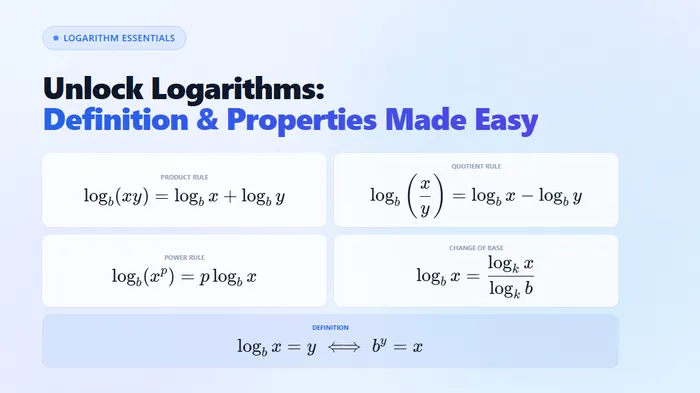
Master logarithms easily! Learn the core definitions, 7 essential properties, and step-by-step examples. Ready to ace your math exam? Read on!
Have you ever wondered how scientists measure the colossal shaking of an earthquake, or how audio engineers calculate the deafening roar of a rock concert? The secret lies in a brilliant mathematical tool that turns scary, giant numbers into friendly, manageable figures: the logarithm. Whether you are calculating the Richter scale of an earthquake, the decibels of sound intensity, or the acidity (pH) of a chemical solution, logarithms are the silent heroes working behind the scenes. Let’s break down this concept together and discover how simple it actually is!
A logarithm is the inverse operation of exponentiation, which allows us to find the exponent to which a base must be raised to yield a given number. Before diving deeper into logarithms, make sure you have mastered the foundational laws of powers in our article Exponents: Definition, Properties, and Practice Problems↝ .
Written mathematically as $\log_a b = c$, it is equivalent to saying $a^c = b$, where a is the base ($a > 0, a ≠ 1$), b is the numerus ($b > 0$), and $c$ is the exponent.
Table of Contents
Common Misconceptions to Avoid
Before we dive deeper, let’s clear up a few traps that trip many students up:
- The Sum Trap: A very common mistake is assuming that $\log(x + y) = \log x + \log y$. This is incorrect! As you will see below, the sum of two separate logarithms actually corresponds to the multiplication of their numbers inside, like $\log_a b + \log_a c = \log_a(b \cdot c)$.
- Negative Base/Numerus: Remember that the base ($a$) and numerus ($b$) must always be strictly greater than zero, and the base cannot equal $1$. You cannot take the logarithm of a negative number or zero in real numbers!
What is a Logarithm? Let’s Define It!
To understand logarithms, think of them as a question: “To what power must I raise my base to get this number?”
Mathematically, the book defines the relation as follows:
📌 Catatan
$$\log_a b = c \Leftrightarrow a^c = b$$
Here is what each letter represents:
- $a$ is the base (basis), which must satisfy $a > 0$ and $a \neq 1$.
- $b$ is the numerus (the number whose logarithm we want to find), which must satisfy $b > 0$.
- $c$ is the value of the logarithm (the exponent).
Pro Tip: In common mathematics and textbooks, if you see a logarithm written without a base (for example, $\log p$), the base is implicitly $10$. So, $\log_{10} p$ is written simply as $\log p$.
The 7 Essential Properties of Logarithms
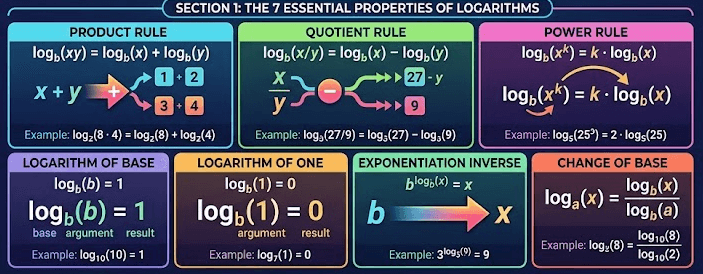
To solve log equations like a pro, you need to master these 7 essential properties. Think of them as your toolbox—each one helps you unpack and simplify complex expressions.
1. The Identity Property
When the numerus is equal to the base, the logarithm is always $1$. $$\log_a a = 1$$
- Why? Because $a^1 = a$.
- Example: $\log_3 3 = 1$.
2. The Zero Property
The logarithm of $1$ with any valid base is always $0$. $$\log_a 1 = 0$$
- Why? Because $a^0 = 1$.
- Example: $\log_5 1 = 0$.
3. The Addition Property (Product Rule)
When you add two logarithms with the same base, you can multiply their numeruses together. $$\log_a b + \log_a c = \log_a(b \cdot c)$$
- Example: $$\log_6 12 + \log_6 3 = \log_6(12 \cdot 3) = \log_6 36 = \log_6 6^2 = 2$$
4. The Subtraction Property (Quotient Rule)
When you subtract two logarithms with the same base, you can divide their numeruses. $$\log_a b - \log_a c = \log_a\left(\frac{b}{c}\right)$$
- Example: $$\log_2 10 - \log_2 5 = \log_2\left(\frac{10}{5}\right) = \log_2 2 = 1$$
5. The Power Property
If either the base or the numerus has an exponent, you can bring those exponents to the front as a multiplying fraction. $$\log_{a^m} b^n = \frac{n}{m} \cdot \log_a b$$
- Note: If the base exponent $m = 1$, this simplifies to $\log_a b^n = n \cdot \log_a b$.
- Example: $$\log_2 125 = \log_2 5^3 = 3 \cdot \log_2 5$$
6. The Base-Change Property
You can change the base of any logarithm to a new base $p$. $$\log_a b = \frac{^p\log b}{^p\log a} = \frac{1}{^b\log a}$$
- Example: If $\log_2 3 = p$, then $\log_3 2 = \frac{1}{p}$.
7. The Chain Property (Multiplication Rule)
If you multiply logarithms where the numerus of the first matches the base of the second, they merge into a single logarithm. $$\log_a b \cdot ^b\log c = \log_a c$$
- Example: $$\log_2 5 \cdot ^5\log 8 = \log_2 8 = 3$$
Step-by-Step Practice Problems
Let’s apply these tools to solve three different levels of questions, from basic recall to analytical problem-solving!
Problem 1: Level - Knowledge & Recall
Evaluate the exact value of $\log_2 32$.
Solution:
- Identify the relationship between the base ($2$) and the numerus ($32$). We can write $32$ as a power of $2$. $$32 = 2^5$$
- Substitute this back into our logarithmic expression: $$\log_2 32 = \log_2 2^5$$
- Use the Power Property (Sifat 5) to bring the exponent $5$ to the front: $$\log_2 2^5 = 5 \cdot \log_2 2$$
- Use the Identity Property (Sifat 1) since $\log_2 2 = 1$: $$5 \cdot 1 = 5$$
Answer: The value of $\log_2 32$ is $5$.
Problem 2: Level - Application
Simplify the following expression: $$\log_3 18 + 2 \cdot \log_3 4 - \log_3 32$$
Solution:
- Use the Power Property (Sifat 5) in reverse to move the multiplier $2$ back as an exponent of $4$: $$2 \cdot \log_3 4 = \log_3 4^2 = \log_3 16$$
- Rewrite our complete equation with this updated term: $$\log_3 18 + \log_3 16 - \log_3 32$$
- Apply the Addition Property (Sifat 3) to the first two terms: $$\log_3 18 + \log_3 16 = \log_3 (18 \cdot 16)$$
- Apply the Subtraction Property (Sifat 4) to include the final term: $$\log_3(18 \cdot 16) - \log_3 32 = \log_3 \left(\frac{18 \cdot 16}{32}\right)$$
- Simplify the fraction inside the logarithm: $$\frac{18 \cdot 16}{32} = \frac{18 \cdot 1}{2} = 9$$
- Evaluate the simplified logarithm: $$\log_3 9 = \log_3 3^2 = 2 \cdot \log_3 3 = 2$$
Answer: The simplified value is $2$.
Problem 3: Level - Reasoning & Problem Solving
If $\log_2 3 = a$ and $\log_2 5 = b$, express $\log_8 60$ in terms of $a$ and $b$.
Solution:
- Use the Base-Change Property (Sifat 6) to convert our base $8$ into base $2$, since both our known variables ($a$ and $b$) are in base $2$: $$\log_8 60 = \frac{\log_2 60}{\log_2 8}$$
- Express the numerus in the denominator as a power of $2$: $$\log_2 8 = \log_2 2^3 = 3 \cdot \log_2 2 = 3$$
- Now, break down the numerus in the numerator ($60$) into its prime factors: $$60 = 5 \cdot 3 \cdot 4 = 5 \cdot 3 \cdot 2^2$$
- Use the Addition Property (Sifat 3) to split the numerator terms: $$\log_2 60 = \log_2(5 \cdot 3 \cdot 2^2) = \log_2 5 + \log_2 3 + \log_2 2^2$$
- Simplify $\log_2 2^2$ using the Identity and Power properties: $$\log_2 2^2 = 2 \cdot \log_2 2 = 2$$
- Substitute the known variables $\log_2 3 = a$ and $\log_2 5 = b$ into the expression: $$\log_2 60 = b + a + 2$$
- Put the numerator and denominator back together to get your final expression: $$\log_8 60 = \frac{a + b + 2}{3}$$
Answer: $\log_8 60 = \frac{a + b + 2}{3}$.
Let’s Test Our Understanding!
Now it’s your turn to shine! Here are 5 practice problems to test your skills. Grab a piece of paper and try solving these without looking at the solutions above.
- Find the exact value of $^5\log 125$.
- Evaluate the value of $^{1/2}\log \frac{1}{4}$.
- Simplify the following expression: $$\log_2 18 + \log_2 6 - \log_2 27$$
- If $\log 2 = 0.3010$ and $\log 3 = 0.4771$, calculate the value of $\log 1.5$.
- If $\log_3 4 = x$ and $\log_3 5 = y$, express $^9\log 20$ in terms of $x$ and $y$.
Logarithms might look intimidating at first glance, but once you realize they are just exponents written backwards, everything clicks into place. By mastering the 7 core properties, you can deconstruct and solve even the toughest-looking math problems with confidence. Keep practicing, and don’t let those numbers scare you!
Ready to level up your algebra game? Once you’ve conquered logs, you can challenge yourself with non-linear math concepts in our next article on Equations and Inequalities of Absolute Value and continue mastering mathematics today!