
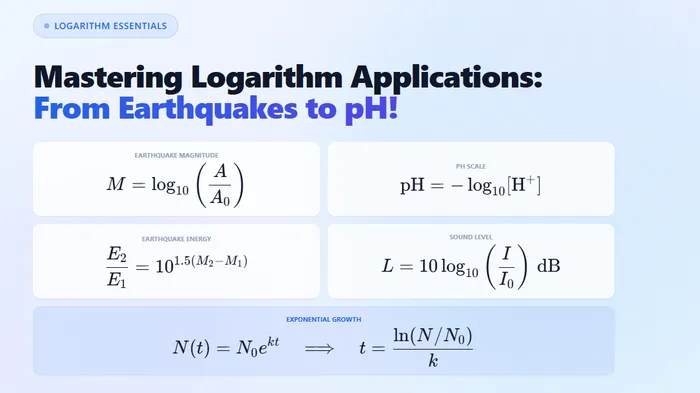
Discover how logarithms help measure earthquakes, chemical acidity, and sound intensity. Learn formulas, step-by-step examples, and test yourself!
Have you ever wondered how scientists measure the massive power of an earthquake or the tiny chemical changes in your favorite lemonade? The application of logarithms allows us to scale down extremely large or infinitesimally small values into manageable, understandable numbers so we can measure sound, acidity, and seismic energy with ease. In this guide, we are going to break down how logarithms work in the real world, explore crucial formulas, tackle step-by-step examples, and bust some common student misconceptions.
Before we tackle logarithms, you might want to brush up on exponents↝ since they are inverse operations! Many students mistakenly believe that logarithmic scales are linear. For instance, they assume that a pH of 4 is twice as acidic as a pH of 8, or that a magnitude 6 earthquake is only slightly stronger than a magnitude 5. In reality, a change of 1 unit on a logarithmic scale represents a 10-fold change in intensity! This means a pH of 4 is actually $10,000$ times more acidic than a pH of 8, and a magnitude 6 earthquake is 10 times more powerful in amplitude than a magnitude 5!
Table of Contents
Real-World Applications of Logarithms
Logarithms are not just abstract math symbols; they are incredibly powerful tools used across physics, chemistry, geology, and even statistics. Let’s explore the four most famous ways logarithms are applied in real life.
1. Taraf Intensitas Bunyi (Sound Intensity Level in Decibels)
Sound waves can range from a tiny whisper to a deafening jet engine. To make these vast numbers easy to read, we use the taraf intensitas bunyi (sound intensity level) measured in decibels (dB).
The formula is defined as: $$TI = 10 \log \frac{I}{I_0}$$
Where:
- $TI$ = taraf intensitas bunyi (sound intensity level in decibels / dB).
- $I$ = intensitas sumber bunyi (intensity of the sound source in $\text{watt/m}^2$).
- $I_0$ = intensitas bunyi minimal (minimum sound intensity audible to humans, which is a constant $10^{-12} \text{ watt/m}^2$).
2. pH Larutan (The Power of Hydrogen)
In chemistry, the acidity or alkalinity of a liquid is measured using the pH scale. The “p” stands for power and “H” stands for Hydrogen.
The formula for determining the pH of a solution is: $$pH = -\log [H^+]$$
Where:
- $[H^+]$ is the concentration of hydrogen ions in the solution, measured in moles per liter ($\text{mol (M)}$).
3. Skala Richter (Measuring Earthquake Magnitude)
Geologists use the Richter scale to describe the magnitude of earthquakes based on seismic waves.
The skala richter rumus is: $$R = \log M - \log M_0$$
Where:
- $R$ = earthquake magnitude on the Richter Scale (SR).
- $M$ = the maximum amplitude recorded by a seismograph (in micrometers / $\mu m$, where $1 \mu m = 10^{-6}\text{ m}$).
- $M_0$ = the maximum amplitude of a level-zero earthquake in the same epicentral distance (in $\mu m$, usually assumed to be $1 \mu m$).
4. Sturges’ Rule (Structuring Grouped Data in Statistics)
When you are organizing large sets of raw data into grouped tables in statistics, you need a systematic way to decide how many classes (intervals) to create. This is where Sturges’ Rule comes in handy!
The formula is: $$k = 1 + 3.3 \cdot \log n$$
Where:
- $k$ = the number of classes (usually rounded to the nearest whole integer).
- $n$ = the total number of data points.
Once you master Sturges’ rule, you can explore how we present this grouped data in statistics and tables↝ .
Step-by-Step Problem Solving
Let’s put our formulas to the test with three levels of practical examples: knowledge/understanding, application, and reasoning!
Example 1 (Knowledge Level): Finding pH
Question:
A chemical solution has a hydrogen ion concentration $[H^+] = 1 \cdot 10^{-4}\text{ M}$. Calculate the pH of this solution.
Solution:
- Identify the given value: $[H^+] = 10^{-4}\text{ M}$.
- State the pH formula: $$pH = -\log [H^+]$$
- Substitute the concentration value into the equation: $$pH = -\log (10^{-4})$$
- Apply the power property of logarithms ($\log a^b = b \log a$): $$\begin{aligned} pH &= -(-4 \cdot \log 10)\\ &= 4 \cdot 1\\ &= 4 \end{aligned}$$
The pH of the solution is 4 (which makes it acidic!).
Example 2 (Application Level): Sound Intensity of a Train
Question:
A high-speed train passes close to a residential complex. At a distance of 10 meters, the average intensity of the train’s sound is $6 \cdot 10^{-5}\text{ watt/m}^2$. Find the sound’s intensity level in decibels (dB). (Use $\log 2 \approx 0.3010$, $\log 3 \approx 0.4771$, and $I_0 = 10^{-12}\text{ watt/m}^2$).
Solution:
- Write down the known variables: $$I = 6 \cdot 10^{-5}\text{ watt/m}^2$$ $$I_0 = 10^{-12}\text{ watt/m}^2$$
- Recall the taraf intensitas bunyi formula: $$TI = 10 \log \frac{I}{I_0}$$
- Substitute the variables: $$TI = 10 \log \left(\frac{6 \cdot 10^{-5}}{10^{-12}}\right)$$
- Simplify the quotient inside the logarithm using exponent rules ($10^{-5} \div 10^{-12} = 10^{-5 - (-12)} = 10^7$): $$TI = 10 \log \left(6 \cdot 10^7\right)$$
- Expand the expression using the logarithm product property ($\log(ab) = \log a + \log b$): $$TI = 10 \left(\log 6 + \log 10^7\right)$$
- Break down $\log 6$ as $\log (2 \cdot 3)$ and simplify $\log 10^7$ as $7$: $$TI = 10 \left(\log 2 + \log 3 + 7\right)$$
- Substitute the given values of $\log 2$ and $\log 3$: $$\begin{aligned} TI &= 10 \left(0.3010 + 0.4771 + 7\right)\\ &= 10 \left(7.7781\right)\\ &= 77.781\text{ dB} \end{aligned}$$
The sound intensity level of the train is $77.781\text{ dB}$.
Example 3 (Reasoning Level): Organizing Data with Sturges’ Rule
Question:
An educator compiles the height of $n = 30$ vocational students to build a grouped frequency distribution table. Determine the optimal number of classes ($k$) using Sturges’ Rule. (Use $\log 3 \approx 0.4771$).
Solution:
- State the Sturges’ Rule formula: $$k = 1 + 3.3 \cdot \log n$$
- Substitute the sample size $n = 30$ into the equation: $$k = 1 + 3.3 \cdot \log 30$$
- Break down $\log 30$ using the product property ($\log 30 = \log (3 \cdot 10) = \log 3 + \log 10$): $$\log 30 \approx 0.4771 + 1 = 1.4771$$
- Plug this log value back into the formula: $$k \approx 1 + 3.3 \cdot (1.4771)$$
- Calculate the multiplication step: $$\begin{aligned} k &\approx 1 + 4.8744\\ &\approx 5.8744 \end{aligned}$$
- Round the final value of $k$ to the nearest whole number to get a practical number of intervals: $$k \approx 6$$
The optimal number of classes for the student height dataset is 6.
Let’s Test Our Understanding!
Test your math skills with these five practice questions. No answers are provided here, so work them out on your own paper!
- Chemical Acidity: A certain shampoo has a hydrogen ion concentration of $[H^+] = 2 \cdot 10^{-6}\text{ M}$. Calculate its pH level. (Use $\log 2 \approx 0.3010$).
- Noise Violation: A residential area has a strict noise limit of $70\text{ dB}$. If a nearby workshop operates a drill that outputs an intensity of $4 \cdot 10^{-5}\text{ watt/m}^2$, is the workshop violating the local law? (Use $\log 2 \approx 0.3010$).
- Earthquake Intensity: An earthquake is registered on a seismograph with a maximum wave amplitude ($M$) of $10,000\mu m$. If the level-zero amplitude $M_0$ is $1 \mu m$, calculate the magnitude of the earthquake on the Richter Scale ($R$).
- Data Grouping: If you are analyzing a large market survey dataset with $n = 100$ respondents, how many classes ($k$) should you construct for your frequency distribution table under Sturges’ Rule?
- Inverse pH: A brand of premium alkaline bottled water claims to have a pH of exactly 8. Calculate the concentration of hydrogen ions $[H^+]$ present in this water.